
CHILLEDDVS
SYSTEM 0 // BOOT
◦ AUDIO ENGINE
◦ RACE TELEMETRY
CHILLEDDVS
TWO WORLDS · ONE SIGNAL
000%
000BPM 174REDLINEONLINE
✓ Server IP copied to clipboard
chilleddvs
notchilleddvs
🐣 Happy Easter! 🥚
🎃 Happy Halloween! 👻
🎄 Merry Christmas! ❄️
🍃 Happy 4/20 — Stay Chilled 💚
Assetto Corsa Community

Welcome to NOTCHILLEDDVS

33
Servers
–
Online Now
–
Drivers
–
Lap Records
24/7
Always On
FREE
No Account
✅ GOAL REACHED

Housing Fund Raised

The fundraiser hit its target.
Thank you to everyone who shared and donated!
Much love to all of you!

Funds Raised 101% Complete
$2,679 of $2,650
52 donors · You did this
View the campaign →
30 Active Servers
Vanilla + Modded
Nordschleife · Spa · Silverstone · Shutoko · Touge
No Registration Needed
Dutch Highway · Assetto Truck Sim · Karting
Join Discord for Race Events
30 Active Servers
Vanilla + Modded
Nordschleife · Spa · Silverstone · Shutoko · Touge
No Registration Needed
Dutch Highway · Assetto Truck Sim · Karting
Join Discord for Race Events
Race Servers & Leaderboards

Pick Your Track

One click opens directly in Content Manager · Status updates every 30s · Leaderboards updated live

– servers online · – racing
3 servers
NEW · AC EVO
🏁
Nordschleife — Assetto Corsa EVO
Our first Assetto Corsa EVO server is live — join from the in-game EVO server browser.
– drivers
online
NEW · AC EVO
🏯
Suzuka — Assetto Corsa EVO
Suzuka Circuit on Assetto Corsa EVO — hop in from the in-game EVO server browser.
– drivers
online
NEW · AC EVO
🏆
Spa GT3 — Assetto Corsa EVO
GT3 race weekends at Spa-Francorchamps — qualifying + 30 min race. Join from the in-game EVO server browser.
– drivers
online
30 servers
System Status
Checking systems…
Loading status…
Live monitoring via Uptime Kuma · refreshes every 30s
Nordschleife · Suzuka · Spa
🏆 Nordschleife Leaderboard
Loading…
30 servers · lap records
Loading tracks…
LEADERBOARD
Pick a track — records are combined across every server running it
LAP TIMES
Loading combined leaderboards…
SDC UNDERGROUND Street RPG · server 11
🏆 Reputation
Loading…
Full SDC Underground board: open /sdc
Live Activity

Speed Trap Feed

Recent violations caught across all servers — updates every 60s

⚡ Latest Speed Traps
No speed traps recorded yet
Hall of Fame

Top Drivers

The best racers across all 30 Assetto Corsa servers — lap records, drift kings, and overtake masters

Loading…
Loading…
Loading…
Loading…
—
Unique Drivers
—
Lap Records
—
Drift Runs
—
Race Records
Live Stream

Watch notchilleddvs Live

Racing sessions, community events, and Assetto Corsa commentary live on Twitch

Live Chat
ChilledDVS
Racing Community Discord
– Online
Join the Discord
Race together · Talk tactics · Stay informed
Connect

Find notchilleddvs

Follow for race highlights, stream clips, and community updates

Community

Join the Discord

The ChilledDVS Discord is where the community lives — race events, setup sharing, mod downloads, and real-time chat while sessions are running. All skill levels welcome.

  • Race events & weekly scheduled sessions
  • Car setup sharing and tuning tips
  • Mod packs and server configuration guides
  • Live race voice channels during events
  • Server feedback, ban appeals & reports
  • Stream go-live notifications
Join Discord
Circuit Guide

Track History

The real-world circuits behind our servers — history, facts, and corner names
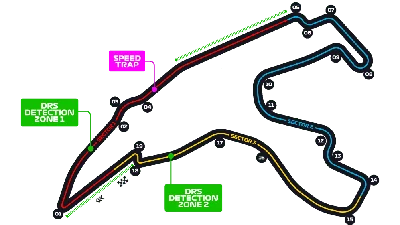
Spa-Francorchamps circuit map
SPA-FRANCORCHAMPS
▼
Belgium 7.004 km Est. 1921

Born in 1921 from public roads connecting the towns of Spa, Malmedy and Stavelot, Spa-Francorchamps is widely regarded as the greatest racing circuit in the world. Nestled in the Belgian Ardennes forest, the original 15km triangle was terrifyingly fast — pure public roads with hay bales for safety. The Raidillon, that iconic uphill sweep after Eau Rouge, was added in 1939 and instantly became one of motorsport's most legendary corners. Fatal accidents plagued the old circuit for decades, forcing a radical redesign in 1979 that created the modern 7km layout we still race today. Jackie Stewart, who won here three times, famously called it the greatest challenge in racing. The circuit hosts the Belgian Grand Prix, the 24 Hours of Spa and remains the spiritual home of endurance racing.
Length
7.004 km
Corners
20
Lap Record
1:44.701
First Race
1921
Corner Names
La Source Eau Rouge Raidillon Kemmel Les Combes Malmedy Rivage Pouhon Les Fagnes Campus Paul Frère Stavelot Blanchimont Bus Stop Chicane
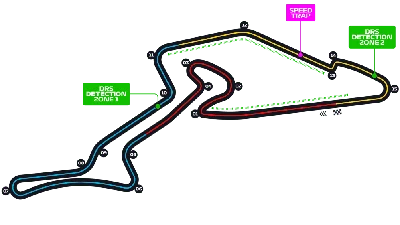
Nurburgring circuit map
NÜRBURGRING NORDSCHLEIFE
▼
Germany 20.832 km Est. 1927

Built between 1925 and 1927 in Germany's Eifel mountains, the Nordschleife is the longest and most demanding permanent racing circuit ever built. Jackie Stewart earned its legendary nickname — "The Green Hell" — after winning here in 1968 through rain and fog with a broken wrist. At over 20km with 300 metres of elevation change and more than 170 corners by some counts, a lap here is said to be worth thousands of kilometres of normal road testing. Every major car manufacturer still tests here. Niki Lauda's near-fatal fire at Bergwerk in the 1976 German Grand Prix ended Formula 1 on the Nordschleife. The fastest ever lap belongs to Timo Bernhard in a Porsche 919 Hybrid Evo — a staggering 5:19.546. Today it remains open to the public for tourist drives at €30 a lap.
Length
20.832 km
Corners
73+ official
Lap Record
5:19.546
Elevation
300m change
Famous Sections
Sabine-Schmitz-Kurve Hatzenbach Hocheichen Flugplatz Schwedenkreuz Aremberg Fuchsröhre Adenauer Forst Metzgesfeld Kallenhard Wehrseifen Breidscheid Bergwerk Kesselchen Karussell Hohe Acht Wippermann Brünnchen Pflanzgarten Schwalbenschwanz Döttinger Höhe
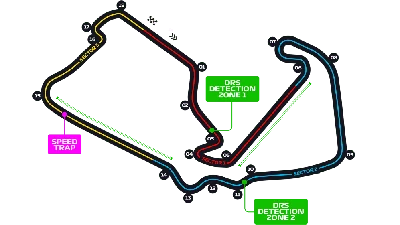
Silverstone circuit map
SILVERSTONE
▼
United Kingdom 5.891 km Est. 1948

Silverstone began life as a RAF bomber base in World War II. In 1948, the Royal Automobile Club transformed the perimeter and runway roads into a racing circuit, and the very first Formula 1 World Championship Grand Prix was held here in May 1950, won by Giuseppe Farina in an Alfa Romeo. The circuit has been heavily modified over the decades — most notably with the addition of the Maggots-Becketts-Chapel complex, one of the most thrilling high-speed sequences in all of motorsport. Copse Corner, which was once taken flat out at over 270km/h, had to be chicaned for safety in the 1990s. The Abbey complex and new Arena section added after 2010 give modern cars the room to race. Home to the British Grand Prix and a beloved test circuit, Silverstone remains the spiritual home of British motorsport.
Length
5.891 km
Corners
18
Lap Record
1:27.097
First F1
1950
Corner Names
Abbey Farm Curve Village The Loop Aintree Wellington Straight Brooklands Luffield Woodcote Copse Maggots Becketts Chapel Hangar Straight Stowe Vale Club
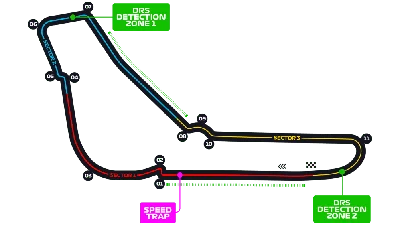
Monza circuit map
MONZA
▼
Italy 5.793 km Est. 1922

The Temple of Speed. Built in just 110 days in 1922 in the Royal Park of Monza north of Milan, it is the oldest purpose-built racing circuit still in use. Monza has hosted the Italian Grand Prix almost every year since the first F1 World Championship in 1950. The original circuit featured a banked oval combined with the road course, but safety concerns led to its removal after 1961. What remains is the fastest circuit on the F1 calendar — average speeds above 260km/h, with cars hitting over 360km/h on the main straight. The slipstream battles and late braking into the Variante Ascari and Parabolica make for some of the most dramatic racing in the world. The tifosi — Ferrari's passionate Italian fans — create an atmosphere unlike anywhere else in motorsport.
Length
5.793 km
Corners
11
Lap Record
1:21.046
First Race
1922
Corner Names
Prima Variante Seconda Variante Curva Grande Variante Ascari Parabolica (Curva Alboreto) Roggia Lesmo 1 Lesmo 2
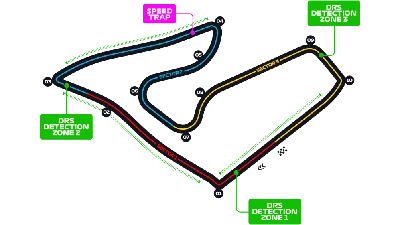
Red Bull Ring circuit map
RED BULL RING
▼
Austria 4.318 km Est. 1969

Carved into the Styrian hills in 1969 as the Österreichring, this circuit became famous for its fast, sweeping layout with dramatic elevation changes and stunning Alpine scenery. The original 5.9km track was one of F1's fastest — an average lap speed exceeding 230km/h. Shortened and rebuilt in 1996 as the A1 Ring, it was then purchased by Red Bull Energy Drinks founder Dietrich Mateschitz and completely renovated in 2011 as the Red Bull Ring. The rebuilt circuit retained the iconic uphill start, the fast approach to Turn 1 and the sweeping final sector. At just 4.3km it is one of F1's shortest circuits, but the combination of heavy braking, fast sweepers and altitude makes it technically demanding. It has hosted both the Austrian and Styrian Grand Prix in recent years.
Length
4.318 km
Corners
10
Lap Record
1:05.619
Altitude
678m
Corner Names
Castrol Edge (T1) Remus (T2) Rauch (T3) Schlossgold (T4) Rindt (T5) Bergwerk (T6) Tiroch (T7) Jochen Rindt (T8) Nissan (T9) Moto GP Kehre (T10)
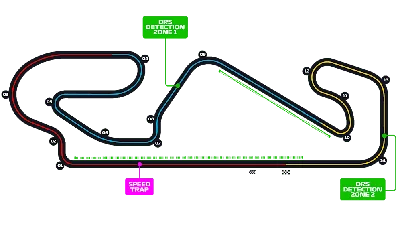
Barcelona circuit map
CIRCUIT DE BARCELONA-CATALUNYA
▼
Spain 4.657 km Est. 1991

Opened in 1991 in Montmeló, north of Barcelona, the Circuit de Catalunya was purpose-built to bring Formula 1 back to Spain following decades without a permanent home. Designed by Hermann Tilke's early work, the circuit quickly became a favourite testing venue — its variety of high-speed corners, technical sections and long straights make it ideal for evaluating car setups across all conditions. The iconic Turn 3 (Renault) is taken at over 240km/h and is one of the hardest corners in F1. The 2016 Spanish GP saw the famous first-lap collision between Lewis Hamilton and Nico Rosberg. The circuit was updated in 2021 with a new chicane replacing the old Turn 10 to encourage more overtaking. Home to both the Spanish and Catalan motorsport scene, it remains one of the most-used test venues in the world.
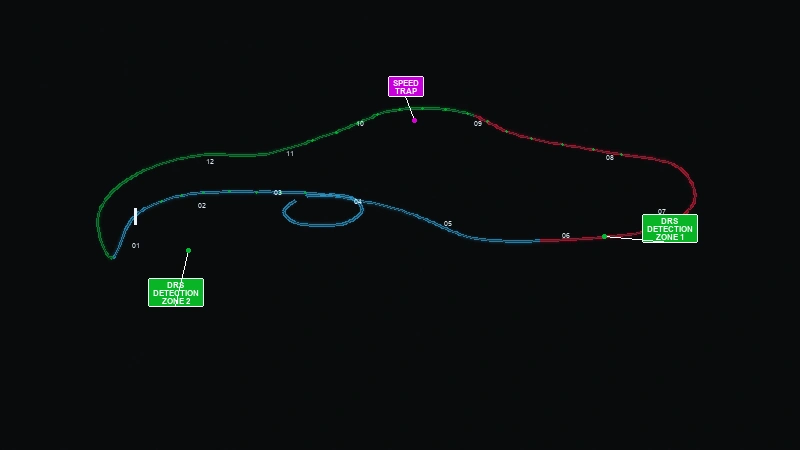
Length
4.657 km
Corners
16
Lap Record
1:18.149
First F1
1991
Corner Names
Elf (T1) Renault (T3) Repsol (T4) Seat (T5) Wurth (T7) Campsa (T9) La Caixa (T10) Banc Sabadell (T12) New Holland (T13) Europcar (T14) Chicane (T15-16)
Vallelunga circuit map
VALLELUNGA
▼
Italy 3.240 km Est. 1951

Located 30km north of Rome in the hills of the Castelli Romani, Autodromo di Vallelunga is one of Italy's oldest and most beloved club racing circuits. Founded in 1951 on land owned by the Diocese of Rome, the circuit started as a simple loop and was expanded several times, with the modern 3.24km layout taking shape in the 1970s. The circuit sits in a natural bowl-shaped valley, giving spectators excellent views across the entire track. Vallelunga has a rich history in Formula 2, Formula 3 and endurance racing, and has served as a development track for Ferrari, Alfa Romeo and many Italian teams. The technical mix of slow hairpins, flowing medium-speed bends and a long main straight reward a well-balanced car setup and precise, smooth driving.
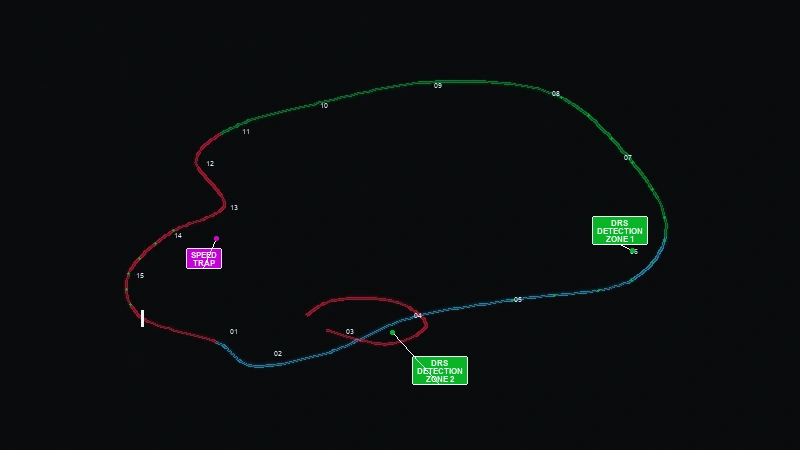
Length
3.240 km
Corners
14
Country
Italy
Founded
1951
Corner Names
Prima Variante Curva Campagnano Curva Grande Curva del Laghetto Tornantino Curva Lunga Ultima Curva
Laguna Seca circuit map
LAGUNA SECA
▼
USA 3.602 km Est. 1957

Nestled in the hills of Monterey County, California, WeatherTech Raceway Laguna Seca opened in 1957 on land leased from the US Army. Its name comes from Spanish meaning "dry lake" — the valley it occupies was once a seasonal lake. The circuit is world-famous for one corner above all others: the Corkscrew. Turns 8 and 8A drop nearly 18 metres in elevation while twisting 180 degrees, making it one of the most visually dramatic and technically demanding corners anywhere in the world. The 1996 CART race saw Alex Zanardi's legendary "The Pass" on Bryan Herta through the Corkscrew — arguably the greatest overtake in American motorsport history. Home to IMSA, IndyCar and MotoGP rounds, Laguna Seca is a beloved classic that perfectly represents the wild, hillside character of American road racing.

Length
3.602 km
Corners
11
Elevation Drop
61m
Founded
1957
Corner Names
Turn 1 Turn 2 Andretti Hairpin (T3) Turn 4 Turn 5 The Rahal Straight Turn 6 Turn 7 The Corkscrew (T8) Rainey Curve (T9) Turn 10 Fog Line (T11)
Mod Downloads

Free Downloads

Car mods and tracks used on our servers — free, direct download, no account required

GET THE MODS

All the car and track mods used across our Assetto Corsa servers in one place. Download them free at downloads.chilleddvs.com — direct links, no fuss, no sign-up.

🚗 Cars 🏁 Tracks Free Direct Download
downloads.chilleddvs.com
  • All car mods used on our servers
  • All custom track packs
  • Organised by category
  • Direct file download links
  • No account or registration needed
  • Updated when servers change mods
Guestbook

Community Wall

Leave a message for the ChilledDVS community — say hi, drop some hype, or shout out a driver.
0 / 280

Loading messages…
Drum & Bass · Electronic Music · DJ Sets

DRUM & BASS

174
BPM
D&B
Genre
24/7
Vibes
🔊
Sub Bass
// BPM TAPPER
-- BPM
✅ GOAL REACHED

Housing Fund Raised

The fundraiser hit its target.
Thank you to everyone who shared and donated!
Much love to all of you!

Funds Raised 101% Complete
$2,679 of $2,650
52 donors · You did this
View the campaign →
Drum & Bass
Liquid DnB
Neurofunk
Dark DnB
Jump Up
Crossbreed
Technoid
Breaks
Hardcore
Jungle
ChilledDVS Sets
174 BPM
Sub Bass Heavy
Drum & Bass
Liquid DnB
Neurofunk
Dark DnB
Jump Up
Crossbreed
Technoid
Breaks
Hardcore
Jungle
ChilledDVS Sets
Subgenres

THE SPECTRUM

From silky liquid rollers to crossbreed, hardcore & beyond — all roads lead to the bass drop

Drum & Bass 160–180 BPM READ HISTORY ↓
Liquid 165–174 BPM READ HISTORY ↓
Neurofunk 172–176 BPM READ HISTORY ↓
Dark DnB 170–175 BPM READ HISTORY ↓
Jump Up 173–178 BPM READ HISTORY ↓
Techstep 170–174 BPM READ HISTORY ↓
Crossbreed 170–180 BPM READ HISTORY ↓
Technoid 150–160 BPM READ HISTORY ↓
Breaks 130–150 BPM READ HISTORY ↓
Hardcore 160–180 BPM READ HISTORY ↓
Jungle 160–180 BPM READ HISTORY ↓
Origin · London, UK
DRUM & BASS
160–180 BPM 1990s – Present

Drum & Bass emerged in the early 1990s from the UK rave scene, evolving directly out of hardcore and jungle. The genre stripped back the samples and reggae influences of its predecessors, placing hyper-fast breakbeats — typically the Amen break and the Think break — at the absolute core.

By 1994–95, producers like Goldie, LTJ Bukem, and Grooverider were shaping what would become a distinct UK sound: dark basslines, complex drum patterns running at 160–180 BPM, and a cinematic, futuristic atmosphere. The term "Drum & Bass" itself began appearing in 1994 as promoters looked for a name that captured the music's two defining elements.

Through the late 90s and 2000s, D&B splintered into dozens of subgenres — liquid, neurofunk, jump up, techstep — each pulling the template in a different direction. Today it remains one of the most technically demanding and creatively rich genres in electronic music.

Defining Break
The Amen Break — a 6-second drum loop from "Amen, Brother" by The Winstons (1969), sampled millions of times and considered the most important break in music history.
Ground Zero
Rage nightclub, London — where Grooverider and Fabio held their legendary residency from 1988, incubating the sound that became D&B.
Breakthrough Moment
Goldie's "Timeless" (1995) — the first D&B album to chart in the UK Top 10, bringing the underground into mainstream consciousness.
Key Artists
Goldie LTJ Bukem Grooverider Fabio Andy C Chase & Status
Origin · London, UK
LIQUID DnB
165–174 BPM Mid-1990s – Present

Liquid Drum & Bass was pioneered primarily by LTJ Bukem, whose Good Looking Records label became the definitive home of the sound from 1992 onwards. Where the wider scene was heading dark and aggressive, Bukem took D&B in the opposite direction — lush pads, jazzy chords, soulful vocals, and rolling basslines that felt more atmospheric than physical.

The sound drew heavily from jazz, soul, and ambient music, with classic breaks still driving the rhythm but buried under layers of texture. Tracks like Bukem's "Music" (1993) and "Horizons" (1995) set the blueprint: cinematic, intelligent, deeply melodic.

Throughout the 2000s, liquid evolved further with producers like Logistics, Netsky, and High Contrast bringing it to a broader audience. Its emphasis on emotion over aggression makes it one of the most accessible and enduring strands of D&B — often described as the genre's "soul music."

Defining Label
Good Looking Records — LTJ Bukem's label launched in 1992, releasing the definitive catalogue of atmospheric, soulful D&B throughout the 90s.
Sonic Signature
Rolling, half-step bass patterns; jazz-influenced chords; ambient pads; soulful vocal samples — warmth and melody at the core.
Cultural Moment
Fabio & Grooverider's Radio 1 show (1998–2008) gave liquid D&B a national platform, cementing it as the mature, sophisticated face of the scene.
Key Artists
LTJ Bukem Logistics High Contrast Netsky Submorphics Calibre
Origin · UK / Europe
NEUROFUNK
172–176 BPM Late 1990s – Present

Neurofunk emerged in the late 1990s as D&B producers pushed into experimental and functional sound design territory. The name was coined by Ed Rush & Optical, whose Virus Recordings label became the genre's spiritual home. Influenced by George Clinton's "neurofunk" concept — the idea of music rooted deep in the nervous system — the sound was deliberately alien, mechanical, and intense.

Where liquid was warm and melodic, neurofunk was cold and surgical: heavily processed "reese" basslines, distorted modulating bass patches, sci-fi atmospheres, and rhythmic complexity that rewarded close listening. The Roland TB-303 and FM synthesis became core tools.

By the 2000s and 2010s, producers like Noisia, Spor, and Audio pushed neurofunk into extreme technical territory. The genre attracted a devoted community of producers obsessed with sound design — today it's widely considered the most technically advanced corner of D&B production.

Name Origin
Coined by Ed Rush & Optical in the late 90s — inspired by George Clinton's concept of "neurofunk" as music embedded in the nervous system itself.
Sonic Signature
The "reese bass" — a heavily modulated, growling, evolving bassline that sits at the centre of almost every neurofunk track.
Defining Label
Virus Recordings — founded by Ed Rush & Optical in 1997, the label that defined the neurofunk sound and aesthetic for a generation.
Key Artists
Ed Rush & Optical Noisia Spor Audio Phace Mefjus
Origin · UK
DARK DnB
170–175 BPM Mid-1990s – Present

Dark Drum & Bass has its roots in the "darkcore" movement of 1992–93, a period when jungle producers began stripping away the happy hardcore elements and replacing them with horror film samples, minor-key basslines, and deeply unsettling atmospheres. It was a direct reaction against the euphoric side of rave culture.

Producers like Goldie, Dillinja, and Lemon D were central to this development — their tracks drawing on horror soundtracks, industrial music, and the bleakest corners of jazz. The classic dark D&B track is cavernous, relentless, and heavy: there's no release, only pressure.

Dark D&B has always maintained a cult following even as the scene evolved. Today it bridges neurofunk, techstep, and darker strains of liquid — sharing a commitment to unease, weight, and the kind of emotional intensity that comes when the sub bass really hits.

Roots
"Darkcore" — the 1992–93 mutation of jungle that replaced euphoric stabs with horror samples, horror film scores, and suffocating basslines.
Defining Sound
Cavernous, distorted sub bass; minor-key atmosphere; no melodic release — sustained tension throughout the track.
Key Track
Dillinja's "Deadly Deep Subs" (1994) — a masterclass in sub bass weight and psychological pressure that still holds up 30 years later.
Key Artists
Dillinja Lemon D Goldie Matrix Calyx & TeeBee
Origin · UK
JUMP UP
173–178 BPM Late 1990s – Present

Jump Up is D&B at its most raucous and unapologetically fun. It developed in the late 1990s as a more accessible, dance-floor-focused alternative to the increasingly dark and technical directions the scene was taking. The emphasis is entirely on the drop: huge, wobbly basslines, simple but devastating rhythms, and maximum crowd energy.

The sound is characterised by its distinctive "neuro-wobble" bass — a modulated, rubbery sound that almost feels cartoonish compared to the surgical precision of neurofunk. Tracks are typically short on atmosphere and long on impact: there's one job, and that's to make the room go off.

Jump Up has faced snobbery from other parts of the D&B scene, but its dancefloor power is undeniable. Artists like Shy FX, Friction, and more recently Hedex have pushed the sound to massive audiences. At its best, Jump Up is pure kinetic joy.

Philosophy
Maximum dancefloor impact above all else — the drop is everything. Often dismissed by purists, always beloved by the crowd.
Sonic Signature
The "wobble bass" — a rubbery, heavily modulated sound that became jump up's trademark. Simple patterns, devastating execution.
Scene Status
Responsible for some of D&B's biggest festival moments — consistently pulling the largest, most energetic crowds in the scene.
Key Artists
Hedex Shy FX Friction Skiba Bou Turno
Origin · UK
TECHSTEP
170–174 BPM 1996–2002 · Revived

Techstep was the most deliberately brutal and industrial subgenre to emerge from D&B in the mid-to-late 1990s. It grew as a reaction against the jazziness of liquid D&B, replacing organic sound sources with purely synthetic, machine-like textures. The sound was stripped bare: hard, processed drum patterns, distorted bass tones, and an almost complete absence of warmth or melody.

Ed Rush & Optical, Trace, and Digital were its key architects — Optical's "To Shape The Future" (1998) and Ed Rush's "Bludclot Artattack" are canonical examples. The music evoked industrial machinery and urban dystopia; it wasn't interested in sounding human.

Techstep peaked commercially around 1997–1999 before much of its aesthetic was absorbed into neurofunk. It's widely considered one of the most influential periods in D&B history — a moment when producers were pushing into genuinely new sonic territory with no roadmap.

Defining Aesthetic
Urban dystopia — machine sounds, industrial textures, zero warmth. A deliberate rejection of the organic and the melodic.
Peak Era
1997–1999 — the period in which techstep went from underground anomaly to dominant sound at raves across the UK and Europe.
Legacy
Directly fathered neurofunk — its DNA lives in almost every modern D&B track that uses synthetic, engineered sound design.
Key Artists
Ed Rush & Optical Trace Digital Nico & Vinz Dom & Roland
Origin · Netherlands / Germany
CROSSBREED
170–180 BPM 2000s – Present

Crossbreed is one of the most aggressive intersections in electronic music — a collision between hardcore, hard techno, and Drum & Bass. The genre fuses D&B's rapid-fire breakbeats with the distorted kicks, industrial textures, and relentless energy of hardcore, creating a sound that's harder than either parent genre alone.

It grew out of the European underground in the 2000s, particularly the Dutch and German scenes where hardcore and D&B communities overlapped. The sound is defined by its willingness to combine elements that "shouldn't" mix: breakbeats and four-to-the-floor kicks, D&B bass design and hardcore distortion.

Crossbreed has remained a niche but deeply passionate scene — producers and fans who feel mainstream D&B has become too clean and polished. Acts like Digital Punk, Ophidian, and Pariah have kept pushing the sound harder and heavier, making it one of the most extreme genres in the electronic music spectrum.

The Fusion
D&B breakbeats + hardcore distorted kicks + industrial textures — genres that shouldn't mix, combined into something harder than either.
Scene Base
The Netherlands and Germany — where hardcore and D&B communities have historically overlapped, creating the conditions for crossbreed to develop.
Ethos
No compromise. Crossbreed exists specifically for listeners who feel that most D&B is too polished — it deliberately pursues extremity.
Key Artists
Digital Punk Ophidian Pariah Rebelion Endymion
Origin · Germany / UK
TECHNOID
150–160 BPM 2010s – Present

Technoid occupies a unique middle ground between techno and D&B — slower than classic drum & bass but faster than most techno, sitting in a tempo zone that allows both the relentless groove of club techno and the rhythmic complexity of breakbeat music. The genre emerged as producers on both sides of the divide began blending the two traditions deliberately.

Unlike crossbreed — which prioritises aggression and heaviness — technoid is primarily focused on groove, hypnosis, and dancefloor functionality. Tracks are typically long and rolling, designed for extended listening in dark club environments. The influence of Berlin techno is palpable in the production aesthetic.

Labels like Metalheadz, Dispatch, and various German imprints have pushed technoid forward. It appeals to a crossover audience of techno heads who want rhythmic sophistication and D&B fans who want deeper, more groove-oriented material.

The Tempo Gap
150–160 BPM — slower than D&B, faster than techno, occupying a unique zone that enables both genres' strengths simultaneously.
Cultural Influence
Berlin's underground techno scene — the minimalist, functional approach to club music that prioritises groove and duration over impact.
Design Philosophy
Tracks built for extended listening — hypnotic, evolving, dark. Less about the drop, more about sustained movement through the night.
Key Artists
Dj Hidden The Outside Agency Prspct artists Counterstrike
Origin · UK / USA
BREAKS
130–150 BPM Late 1980s – Present

Breakbeat — or Breaks — is the broad family of music built around sampled or synthesised drum breaks. It predates D&B, stretching back to hip-hop's origins in the Bronx in the late 1970s, where DJs like DJ Kool Herc isolated the percussion breaks of funk and soul records and looped them endlessly. This single technique essentially created modern electronic music.

By the late 1980s and early 1990s, breakbeat had evolved into multiple UK strands: hardcore, jungle, and eventually D&B. But "Breaks" as a standalone genre — typically sitting at 130–150 BPM — became its own thing through acts like The Chemical Brothers, Fatboy Slim, Propellerheads, and The Prodigy, who brought breakbeat into mainstream culture.

Today breaks encompasses everything from funky breaks to nu-skool breaks to breakbeat techno — a vast category united only by the primacy of the syncopated, rolling drum pattern at its heart.

The Original Break
DJ Kool Herc, Bronx, 1973 — isolating and looping the percussion break of "Give It Up or Turnit a Loose" by James Brown. The moment that started it all.
UK Explosion
The Prodigy's "Music for the Jilted Generation" (1994) — the album that brought breakbeat into mainstream consciousness and changed the face of UK music.
Foundation
Without breakbeat culture, there is no jungle, no D&B, no drum machine culture, no modern electronic music as we know it. Everything comes from the break.
Key Artists
The Prodigy Chemical Brothers Fatboy Slim Basement Jaxx DJ Kool Herc
Origin · UK / Netherlands
HARDCORE
160–180 BPM Early 1990s – Present

Hardcore — in the UK rave context — emerged from the acid house and breakbeat house scenes of the late 1980s. By 1991–92, "happy hardcore" had become a distinct UK phenomenon: fast breakbeats, pitched-up vocal samples, euphoric piano stabs, and an almost overwhelming energy that defined the illegal rave era.

The Dutch gabber/hardcore scene developed in parallel, taking a harder route: distorted four-to-the-floor kicks at extreme tempos, industrial aesthetics, and a deliberate ugliness that was the antithesis of the UK's euphoric approach. These two traditions — UK happy hardcore and Dutch gabber/industrial hardcore — represent the genre's two poles.

Hardcore has never gone away. UK Hardcore remains a staple of the club circuit through labels like Bonkers; European hardcore has evolved through terror, frenchcore, and uptempo, with BPMs now regularly exceeding 200. The hardcore community is one of the most loyal and insular in all of electronic music.

UK vs Dutch
Two parallel traditions: UK happy hardcore (euphoric, pitched-up vocals, breakbeats) vs Dutch gabber (distorted kicks, industrial brutality, 180+ BPM).
The Rave Era
1992–1994 — the UK's illegal rave scene at its peak. Hardcore was the soundtrack, played in fields and warehouses to tens of thousands every weekend.
Current Extremes
Frenchcore regularly exceeds 200 BPM; uptempo pushes past 220. The genre has no speed limit and shows no sign of slowing down.
Key Artists
Hixxy Sy & Unknown Angerfist DJ Paul Neophyte Scott Brown
Origin · London, UK
JUNGLE
160–180 BPM 1992–1995 · Revived

Jungle is the direct ancestor of Drum & Bass and one of the most culturally significant genres to ever emerge from the UK. It developed in London's Black communities in 1992–93, fusing hardcore rave breakbeats with Jamaican sound system culture — reggae bass, ragga samples, toasting MCs, and dub-influenced production techniques.

The result was something entirely new: breakbeats running at 160+ BPM over sub-bass that could only have come from the reggae tradition, topped with MC vocals, ragga samples, and a communal energy that connected directly to dancehall culture. Tracks like "Original Nuttah" (UK Apachi & Shy FX, 1994) captured the moment perfectly.

By 1995–96, jungle began splitting: the music that kept the ragga and reggae elements became known as "jungle proper," while the strand that stripped them away became "Drum & Bass." Today jungle is experiencing a significant revival, with a new generation of producers and listeners returning to the rawness and cultural richness of the original sound.

Cultural Fusion
UK rave + Jamaican sound system culture — the meeting of hardcore breakbeats and reggae/dancehall bass that created an entirely new art form.
Defining Track
"Original Nuttah" — UK Apachi & Shy FX (1994). The most important jungle record ever made; a perfect document of the genre at its peak.
The Split
1995: jungle kept the reggae; D&B dropped it. The bifurcation produced two entirely distinct genres from one common ancestor.
Key Artists
Shy FX UK Apache Ragga Twins General Levy Congo Natty 4hero
Production Lab

BEAT LAB

A drum machine, a tracker and a sampler in your browser. Chop a break, chain patterns into a song, export a real WAV — free, no install.

Grid sequencer16 genre & famous-break presets, each with producer tips
TrackerThe Amiga way — 32 rows, 6 channels, type notes like a keyboard
SamplerLoad your own break, auto-chop it, play the slices
Song mode + WAVChain patterns into a track and export it
Open the Beat Lab  →
DJ Sets & Mixes

THE SETS

Curated mixes recorded live — raw energy, proper selection, no fillers

Live Stream

TUNE IN LIVE

Live DJ sets, new music reactions, and late-night sessions on Twitch

Live Chat
ChilledDVS
DJ Community Discord
– Online
Join the Discord
Sets · Mixes · Live events
Find Me Online

CONNECT

Sets, clips, updates, and behind-the-scenes content across all platforms

Crews & Collectives

THE TEAMS

Proud member of these DnB crews and collectives — join their Discords to get connected

UNITED BY BREAKBEAT
DnB Collective · Pushing the scene forward through music, community, and relentless energy on the dance floor.
🔵 Join Discord Meet the crew on Twitch ↗
1134
Crew built on bass weight and selector skills. Heavy sounds, real heads, no compromise on the music.
🔵 Join Discord Meet the crew on Twitch ↗
BRWCRW
Our newest Twitch crew. Meet the DJs, catch their live sets, and hear their DnB sessions on Chilled Frequencies.
🔵 Join Discord Meet the crew on Twitch ↗
LOCO
Our newest Twitch crew. Catch the Loco DJs live and hear their drum & bass sessions on Chilled Frequencies.
Meet the crew on Twitch ↗
AFTER PARTY CREW
The night doesn't end at last call. After Party Crew keeps the vibe alive — post-rave sessions, quality selectors, pure energy.
🔵 Join Discord
Official Partners

PARTNERS

Products the ChilledDVS crew uses and endorses — grab an exclusive discount

MILKDROP 3 PRO
The next-gen audio-reactive visualizer. Trippy visuals for your sets and streams — a ChilledDVS favorite.
Use code CHILL → 10% OFF
🛒 Get MilkDrop 3 PRO ⚡ Direct Checkout
Guestbook

Community Wall

Leave a message for the ChilledDVS crew — say hi, drop some hype, or shout out a set.

0 / 280

Loading messages…
🎮 Click Simon
CHILLED FREQUENCIES
live drum & bass
Event liveDrift Cup